
REVIEW · HISTORICAL TOURS
Walking Tour Through Quebec City’s History
Old Quebec moves at walking speed. This 2-hour history stroll threads 400 years of Quebec City through streets you can actually feel.
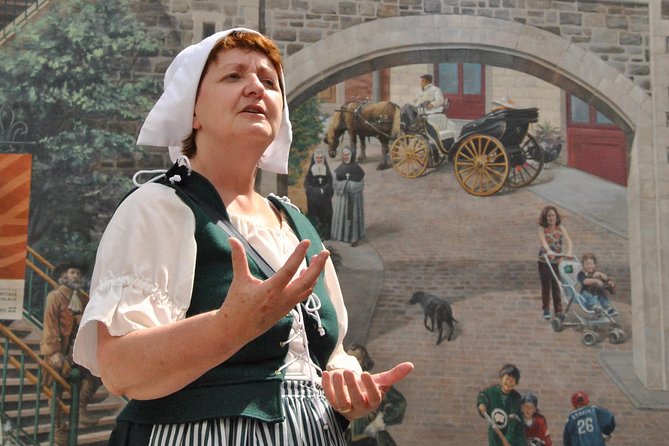
I like that the tour is guided by a period-costumed local, with storytellers who answer questions instead of rattling facts. On recent walks, I’ve seen names like Keven, Mark, Annabelle, Ives, Guy, Louise, Chantal, and Gary popping up in guide stories, and they each bring the city to life in their own style.
One thing to weigh up: it is a hilly, stair-heavy old-city route. If your legs or hearing are your limiting factors, plan for uneven cobbles and some steep descents.
In This Review
- Key things to know before you go
- Old Quebec in 2 Hours, With a Period-Costumed Guide
- Dufferin Terrace: The River View That Makes the City Make Sense
- Basilica Notre-Dame de Québec and the Holy Door Moment
- Place Royale: Champlain’s 1608 Footprint
- Petit-Champlain: Streets That Feel Like a Time Machine (With Hills)
- L’Escalier Casse-Cou: Breakneck Steps and the Photo View Over Rue du Petit-Champlain
- What the 20-Person Group Size Does for Your Experience
- Value, Price, and Timing: Does It Make Sense for Your Trip?
- Who Should Book This Old Quebec Walk
- Book It, or Skip It? My Straight Answer
- FAQ
- How long is the walking tour?
- How much does the tour cost?
- Is the tour offered in English?
- What size group is this tour?
- Where does the tour start and end?
- Do I get a ticket on my phone?
- What fitness level do I need?
- Are service animals allowed?
- What happens if the weather is bad?
- Are there any areas on the route where entry fees apply?
Key things to know before you go
- Small-group size (max 20) keeps it conversational, with time for questions
- Period-costumed guides make the history feel like a scene, not a lecture
- Old Quebec’s only-walled-city claim helps you understand why this place was worth defending
- Riverfront views from Dufferin Terrace give context for everything you’ll see next
- Petit-Champlain + L’Escalier Casse-Cou is the photo stop, with real uphill/downhill work
Old Quebec in 2 Hours, With a Period-Costumed Guide
This is a compact walk designed to give you the lay of the land fast. You cover classic Old Quebec highlights without spending your whole day doing logistics. The format is simple: a local guide, small group, and a steady route through the places that shaped Quebec City.
What makes it especially good value is the way you get both big-picture history and street-level orientation. You’re not just looking at buildings. You’re learning why they matter, and that helps you wander on your own later with more confidence. The guides are also genuinely social with the group. In multiple guide-led experiences I reviewed, guests praised how well the guide handled questions and kept the mood entertaining.
Timing matters here. At around 2 hours, you’ll cover several key areas, but you still need to stay present. If you like slow travel, pair this with unstructured time afterward, especially around the ending point in Place Royale.
More History Tours in Quebec City
- Evening Gourmet Tour 5 Course Dinner – History and Food in Old Quebec City
★ 5.0 · 496 reviews - Quebec City: Old Quebec Historical Walking Tour
★ 4.8 · 409 reviews - Combo Historical and Food Tour of Old Quebec
★ 5.0 · 360 reviews
Dufferin Terrace: The River View That Makes the City Make Sense
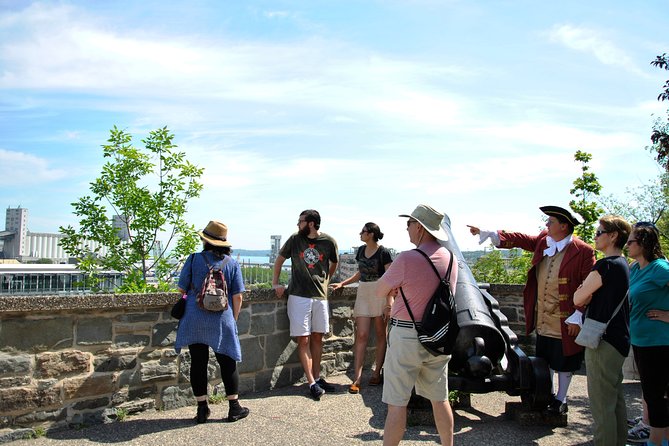
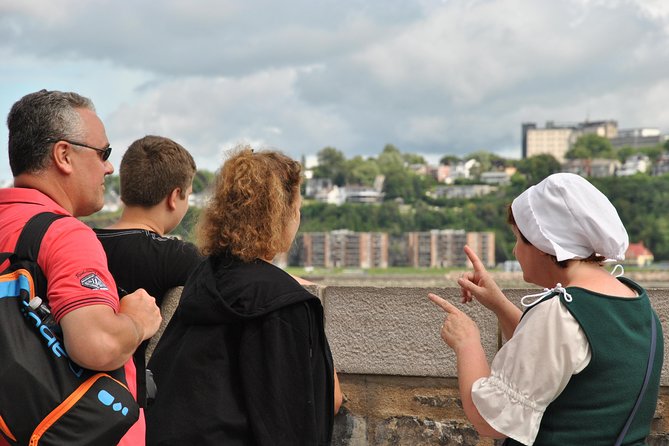
You start at Terrasse Dufferin, right by Château Frontenac, on a long wooden walkway above the St. Lawrence River. This stop is quick, but it sets the stage. When you can see the river and the surrounding area, Quebec City stops feeling like a set of pretty postcards and starts feeling like a strategic port.
Practical tip: this is one of those “look now, thank yourself later” moments. After you see the river from here, the later stops feel less random. You’ll understand how the terrain and water access shaped movement, defense, and where important buildings ended up.
Also, even though the stop itself is brief, the route overall includes rises and descents. Some people found the downhill portion challenging when the tour goes toward the waterfront. Wear shoes with good grip and keep your eyes up on cobbles when you transition into the lower streets.
Basilica Notre-Dame de Québec and the Holy Door Moment
One of the tour anchors is the Basilica of Notre-Dame de Québec (the cathedral on the site tied to the city’s early era). You’ll learn what stands there and why it matters to New France and Quebecois life over centuries.
Here’s what makes this stop more than a quick exterior photo break:
- The cathedral is described as standing in the same location since 1647, which gives a real sense of continuity.
- You’ll hear about the people connected to it, including four governors of New France, bishops of the diocese of Québec, and a funerary chapel dedicated to François de Laval.
- You’ll also be pointed toward notable features inside, including the Holy Door, when it’s relevant to what the guide is discussing.
This is the kind of stop that pays off if you like context. If you’re the type who thinks, why does this building matter, this guide-style storytelling helps you answer that question on the spot. If you prefer minimal standing and maximal scenery, you may want to keep an eye on the group pace and make sure you can enjoy the interior details without feeling rushed.
Place Royale: Champlain’s 1608 Footprint
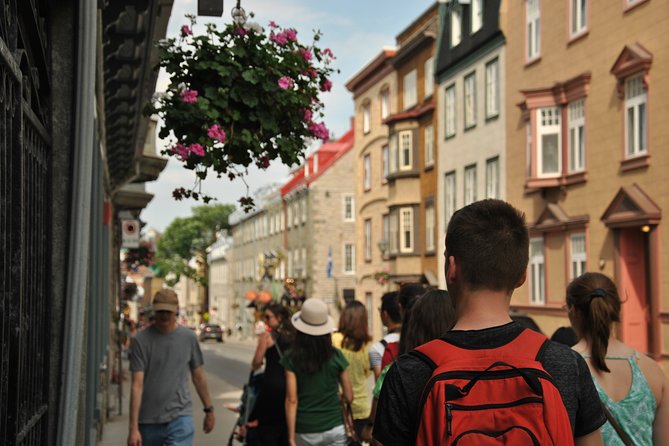
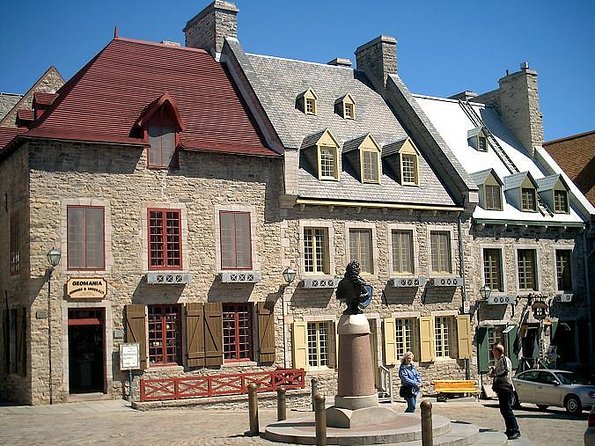
Next you land in Place Royale, often the emotional heart of Old Quebec. This is where Samuel de Champlain founded the city in 1608. Even if you’ve heard his name before, the guide helps you connect that founding moment to what you see today.
Two details make this square hit harder than a generic historic plaza:
- You get a clear sense of blended French and British influence in the buildings around you.
- You learn about the square’s claim to the oldest stone church in North America, which helps explain how the area anchored early urban life.
Spend the time here with your eyes moving. Look at how the buildings frame the space. Notice what feels central and what feels like an edge. That’s how Place Royale stops being just a stop on your route and becomes a mental map you can reuse later.
The tour ends at Place Royale as well, so the square is both a highlight now and a useful place to return to after the walk. If you want an easy self-guided plan, you can use this area to expand outward in whatever direction feels best once your guide has done the first orientation work.
More Walking Tours in Quebec City
- Quebec City Walking Tour
★ 5.0 · 4,716 reviews - Old Quebec City: Grand Walking Tour with Private Option
★ 4.8 · 2,609 reviews - Old Quebec Classique Walking Tour with Funicular
★ 5.0 · 1,317 reviews - Quebec: Crimes of New France Animated Walking Tour
★ 4.6 · 926 reviews
Petit-Champlain: Streets That Feel Like a Time Machine (With Hills)
After Place Royale, the tour steps into Quartier Petit Champlain, the area that makes people say they feel like they’ve landed in a fairytale. The streets have that compressed, storybook energy, and when a guide explains the timeline behind what you’re seeing, it comes alive in a different way.
This stop is longer than the quick-view moments, which helps. You’re given time not just to pass through, but to absorb the street layout. That matters, because Petit-Champlain has a way of pulling you off your direct route if you let it.
Also, plan for the physical side. Reviews included reminders that Old Quebec can mean hills, cobblestones, and stairs. If you’re bringing kids or you’re traveling with anyone who tires quickly, consider doing this tour early in your trip so you’re not depleted by the time you reach the steep sections.
If you want photos, you’ll have plenty of chances. But don’t spend your whole time with your phone. The guide’s best value is how they connect street corners and buildings to what happened before they existed.
L’Escalier Casse-Cou: Breakneck Steps and the Photo View Over Rue du Petit-Champlain

The final major wow factor is L’Escalier Casse-Cou (Breakneck Steps). It’s an outdoor staircase known as the oldest in Québec City, tied to the beginning of the French colony.
Here’s why it’s worth the effort:
- You get a classic view over rue du Petit-Champlain, which is one of the area’s most picturesque streets.
- It turns the history into something physical. You literally climb through the city’s built form.
It’s also a good place to regroup. If the earlier sections feel fast, this is where you can slow down for a second, take photos, and just enjoy the geometry of the old streets below.
One caution: the name alone suggests what your legs will feel. Go at a steady pace. If you feel unsteady on stairs, don’t try to rush for the best shot. You’ll still get great views without turning it into a workout you didn’t plan.
What the 20-Person Group Size Does for Your Experience
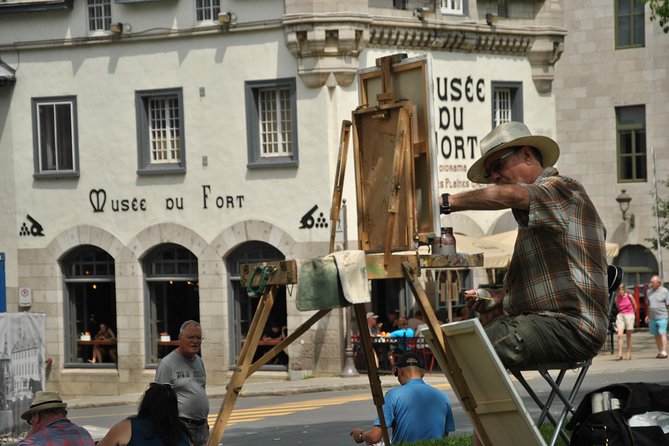
Small groups are a big part of why this works. With a maximum group size of 20 travelers, you’re not competing with crowds for the guide’s attention. People consistently praised how guides handled questions and adjusted the flow so the walk didn’t turn into a one-way talk.
This also affects pacing. When the group can ask what you’re actually wondering, the history sticks better. Instead of memorizing dates, you start understanding cause and effect: why a place was built where it was, why walls mattered, why certain religious and civic spaces became anchors.
There’s also an entertainment layer. Several guides presented in character, bringing a “period person” voice and dramatic timing to the storytelling. Some guests loved that theatrical tone. One note stood out from feedback: for a few people, the presentation style can feel a bit too strong at times. If you’re very sensitive to performance acting, just know you’re not signing up for a quiet museum lecture. This is history as a show, with accuracy behind it.
Value, Price, and Timing: Does It Make Sense for Your Trip?
The tour price is $24.03 per person for about 2 hours, and that pricing works well if you want a fast orientation and a story-driven route. At that cost, you’re paying for three things:
1) a local guide who can explain what you’re seeing,
2) an efficient route through key spots without wandering randomly,
3) the extra layer of period-costume storytelling.
It’s not a bargain “just walking around” experience. You’re getting narrative context, and that helps you enjoy the city later without needing to constantly read signs.
Booking trend noted: on average, it’s booked about 24 days in advance. That suggests popular time slots fill up. If you have tight plans, grab your preferred date rather than assuming you can always walk up.
For best timing, consider this early in your visit. You’ll leave with a mental map that makes the rest of your days easier.
Who Should Book This Old Quebec Walk
This tour is a strong fit if you:
- want a structured walk that still leaves room to explore on your own afterward
- enjoy history when it’s told as stories tied to real places
- like seeing big landmarks and then connecting them to the smaller street details
It may be a less comfortable fit if you:
- have limited mobility or you struggle with stairs and steep hills
- need frequent rest stops, since the route includes cobblestones and elevation changes
- prefer very quiet sightseeing over a guide-led character performance
If you bring someone who tires quickly, make the plan kinder: do not book it at the very end of a long travel day.
Book It, or Skip It? My Straight Answer
Book it if you want Old Quebec to feel understandable fast. The combination of small-group size, a period-costumed local guide, and a route that hits Dufferin Terrace, Notre-Dame de Québec, Place Royale, Petit-Champlain, and L’Escalier Casse-Cou is exactly what you want on a first serious day in the city.
I’d think twice if you know you’ll struggle with steep sections. The scenery is worth it, but the route is not flat. If you can manage uneven streets and stairs with a slow pace, you’ll get a lot out of the guide’s explanations.
FAQ
How long is the walking tour?
It lasts about 2 hours.
How much does the tour cost?
The price is $24.03 per person.
Is the tour offered in English?
Yes, it is offered in English.
What size group is this tour?
The group has a maximum of 20 travelers.
Where does the tour start and end?
The start is at 12 Rue Sainte-Anne, Québec, QC G1R 3X3. The tour ends at Place Royale (Royal Place), Québec, QC G1K.
Do I get a ticket on my phone?
Yes. You receive a mobile ticket.
What fitness level do I need?
A moderate physical fitness level is recommended. The route includes hills and stairs.
Are service animals allowed?
Yes, service animals are allowed.
What happens if the weather is bad?
The tour requires good weather. If it’s canceled due to poor weather, you’ll be offered a different date or a full refund.
Are there any areas on the route where entry fees apply?
The itinerary highlights note free admission at each listed stop.
More Historical Tours in Quebec City
- Quebec City’s History in Virtual Reality
★ 4.5 · 141 reviews - Quebec City: Historical Walking and Tasting Tour
★ 4.8 · 70 reviews - Quebec City: Historic District Walking Tour (2h)
★ 5.0 · 4 reviews - Victoria Guided Food and History Tour
★ 5.0 · 2,015 reviews
Recently listed around Quebec City
- The Montagnarde: Guided horseback ride on mountain trails.★ 4.9 · 13 reviews
- Stoneham: Nordic spa Thermal Experience★ 4.9 · 20 reviews
- Quebec City: Rafting or kayaking – Jacques-Cartier Canyon★ 4.7 · 7 reviews
- Quebec City’s History in Virtual Reality★ 4.5 · 141 reviews
- Quebec Interactive Street Theatre: “Crimes in New France”★ 4.6 · 175 reviews
- Quebec : Old Town Walking Tour With A Local Guide★ 4.5 · 38 reviews
- Quebec: Christmas Interactive Walking Tour of New France★ 4.3 · 7 reviews
- Quebec City Sunset Sea-Kayaking Tour with Mapple Wine★ 3.5 · 3 reviews
Historical Tours, compared.



Evening Gourmet Tour 5 Course Dinner – History and Food in Old Quebec City
Read our review →

Browse the lists this tour appears in