
REVIEW · WALKING TOURS
The Sights of Canmore: a Smartphone Audio Walking Tour
Canmore moves at your pace. This smartphone audio walking tour uses location-based commentary plus a trivia game that keeps the stroll fun. You get the freedom to start and stop when you want, not when a group schedule says so.
I like how the route mixes easy town walking with real stories you can connect to what you see. You’ll hit spots tied to coal mining days, like the coal mining cars monument, and you’ll also learn why the Big Head Sculpture ended up shaping Canmore’s name.
One thing to consider is that some stops involve places that may have separate admission, like the Canmore Museum and Geoscience Center. Also, you’ll want to count devices carefully since the number of travelers you select is the number of devices you can download the tour to.
In This Review
- Key things to know before you go
- Smartphone audio in Canmore: why this format works
- Price and timing, with real value in mind
- How you use it on your phone, without stress
- The route overview: an easy loop through Canmore’s key corners
- Stops 1 to 5: galleries, railway clues, and the animal sculptures
- Three Sisters Gallery, the start of the story
- Railway Avenue and the Canadian Pacific Railway effect
- The British red telephone box corner
- Black bear sculpture
- Grizzly bear sculpture and what differs
- Stops 6 to 10: mountain-name stories, an inukshuk, and coal mining cars
- Mountain views at 15 Street
- Inukshuk at 17 Street
- Coal mining cars monument at Railway Avenue
- Policeman’s Creek Boardwalk stretch
- Stops 11 to 15: Isabelle Dube, Canmore Museum, Japanese friendship, and Main Street
- Isabelle Dube mural at 719 10 Street
- Canmore Museum and Geoscience Center
- Friendship Park and Higashikawa
- Main Street shopping at 8 Avenue and 6 Street
- Canmore Inn & Suites, built in 1890
- Stops 16 to 20: miners, policing, a church, Centennial Park, and the Big Head
- Miners’ Union Hall and the tough relationship
- Ralph Connor Memorial United Church
- NWMP Barracks and maintaining law and order
- Centennial Park, Three Sisters views, and events
- Big Head Sculpture, and why it shaped the town’s name
- How to make the walk feel like your own day
- Who this tour suits best (and who might skip it)
- Should you book this smartphone audio tour?
Key things to know before you go
- Start and stop anywhere along the route, so you can pause for photos, coffee, or detours.
- Live GPS map and auto-playing audio guide you as you get close to each point.
- A location-based trivia game appears after each audio segment, and it’s optional.
- Town history is built into the walk, from coal mining to law and order in Canmore’s rough days.
- Mountain-name stories come with the views, including Princess Margaret Mountain and others.
- Several stops are outdoor and free, so even on a short day you still get good payoff.
Smartphone audio in Canmore: why this format works

Canmore is the kind of place where small details matter. This tour leans into that. Instead of a big bus or a tight group sprint, you follow a self-guided route while audio kicks in at each location.
Two things make it especially satisfying. First, the audio guide is triggered when you arrive near each stop, so it feels like the story belongs to that exact corner. Second, the trivia adds a playful challenge. You listen, you watch the scene in front of you, then you answer on your phone.
You also get flexibility. The tour is designed so you can stop and start along the route. That means if you want to linger at Policeman’s Creek Boardwalk or duck into Main Street shops, you can without feeling like you’re falling behind.
And because you’re paying for an audio experience instead of a guided group tour, the value is strong. At $8.22 per person, it’s a budget-friendly way to get context for what you see on foot.
More Walking Tours in Banff & Lake Louise
- Canmore: Stargazing and Nature by Nightfall Walking Tour – 2hr
★ 5.0 · 31 reviews - Canmore: Wilderness & Wildlife Tour – 2hr Walk
★ 5.0 · 29 reviews - Canmore Town Walking Tour with Refreshment and Sweet Treat
★ 5.0 · 27 reviews
Price and timing, with real value in mind
This is listed as about 1 hour 30 minutes to 2 hours, and the walk is around a 5 km return. That’s an ideal length for a day in the Canadian Rockies when you want movement but not a full half-day hike.
At $8.22 per person, the price feels fair because you’re buying three things at once: guided interpretation (so the places mean something), route support (so you don’t waste time guessing), and entertainment (the trivia game). If you like learning while walking, it’s hard to beat.
Timing-wise, you can go any day and at any time of day. There are no strict hour limitations during the activity window, which is great if you’re matching your plan to weather. And since it’s booked about 6 days in advance on average, it’s smart to reserve ahead if you’re traveling in peak season or want to download for multiple devices at once.
How you use it on your phone, without stress
This tour is built to be simple to run. You download it on Wi-Fi before you go. The tour is designed so you don’t need a signal or data during the walk, which matters in mountain towns where reception can be spotty.
You’ll also use a live GPS map that shows where you are and where to go next. As you get close to each stop, the commentary automatically plays. That means you’re not constantly tapping menus. You’re mostly walking, looking, and listening.
One practical detail: the number of travelers you choose is the number of devices you can download the tour to. If you’re traveling as a couple and each of you wants audio on your own phone, select two devices. If one person will share audio from a single device, you’ll still need to match how the tour download limit works for your group.
The route overview: an easy loop through Canmore’s key corners
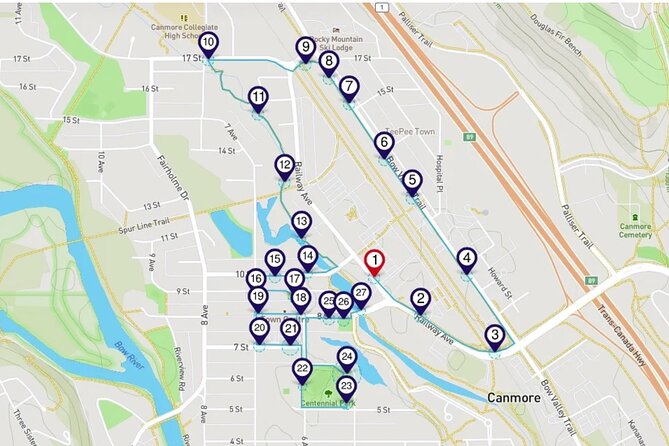
The walking route threads through town highlights that make sense for a 1.5 to 2 hour stroll. You start at 909A Railway Ave and end back at the same meeting point.
You’ll cover a mix of outdoor sculptures, sidewalks and boardwalk sections, and a few spots where you can pause near buildings and museums. Many stops are brief, about 3 minutes each, with longer stretches where the tour wants you to actually take in the setting, like the boardwalk and some park moments.
The flow is also smart. You start with an art and history-focused area (Three Sisters Gallery), then you move into railway and street-level landmarks (Railway Avenue, telephone box corner, bear and grizzly sculptures). Later you shift to viewpoints and names of mountains, then to murals and museums, and finally into the heavier history stops tied to miners, policing, and law and order, ending with the Big Head Sculpture.
If you’re the type who likes a plan but hates rigid schedules, this route hits the sweet spot.
A few more Canmore days to compare
- Bites and Sites of Canmore Walking Food Tour
★ 5.0 · 26 reviews - The Canmore HISTORY TOUR – Cowboys and Coal Miners 2H Walk
★ 4.7 · 17 reviews - PRIVATE Wilderness and Wildlife Walking Tour – 3hrs
★ 4.9 · 17 reviews - Canmore Cowboys and Coal Miners History Tour – 2H Walk
★ 4.5 · 15 reviews
Stops 1 to 5: galleries, railway clues, and the animal sculptures
Three Sisters Gallery, the start of the story
Stop 1 is your entry point into Canmore. You begin at Three Sisters Gallery and start listening as you explore. The tour is built around a walk that brings you past attractions tied to the coal mining era, including places like the Canmore Miner’s Union Hall and NWMP Barracks (which show up later in the route, but the audio introduces the overall theme early).
You’ll also get pointed toward Policeman’s Creek Boardwalk during the early context, and the audio helps you connect those dots so the rest of the loop feels coherent.
One tip: treat the first stop as orientation. If you walk out here with your phone ready, you’ll have the audio rhythm set for the entire tour.
Railway Avenue and the Canadian Pacific Railway effect
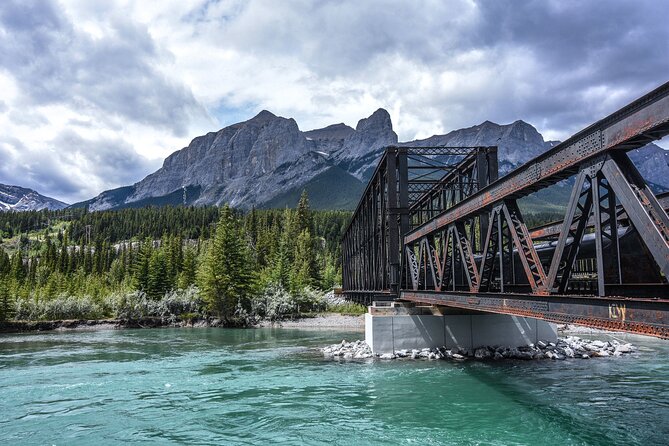
Stop 2 sends you to Railway Avenue and the Bow Valley Trail, where you cross the railway tracks. This is where the tour frames how the Canadian Pacific Railway influenced Canmore’s development. Even if you’ve seen railways all over the Rockies, it’s a useful perspective because it connects infrastructure to the town’s growth.
If you like “why it happened” stories, this stop pays off. If you only care about scenic photos, you might find it a bit more historical than visual.
The British red telephone box corner
Stop 3 is short but fun. You’ll spot the iconic British red telephone box at the corner of Sidney Street and Bow Valley Trail. These things are everywhere in film and old photos, but the tour helps you understand the significance in a Canadian setting.
This is a good reminder of how the audio tour blends the cute with the meaningful. You get a quick win, then you move on.
Black bear sculpture
Stop 4 takes you to a black bear sculpture at Hospital Place and Bow Valley Trail. The audio commentary gives context on black bears in Canmore and the Rocky Mountains.
It’s the kind of stop that works even if you’re not a wildlife person. You’re not asked to hike into wilderness. You’re learning how the animals fit into the region where you are walking.
Grizzly bear sculpture and what differs
Stop 5 follows with a grizzly bear sculpture at Bow Valley Trail and 13 Street. Here, the tour explains differences between black bears and grizzlies.
If you’re curious about safety and basics, this is one of the best sections for practical awareness without scaring you. You’re learning from art and interpretation, not from a lecture.
Stops 6 to 10: mountain-name stories, an inukshuk, and coal mining cars

Mountain views at 15 Street
Stop 6 is where the audio shifts from animals to views and names. At Bow Valley Trail and 15 Street, you get a mountain view to the north. The tour then shares how peaks like Princess Margaret Mountain, Squaw’s Tit, Mount Charles Stewart, Mount Lady MacDonald, and Mount Grotto got their names.
This is one of the tour’s most memorable segments because it turns what could be a quick photo into a story you carry with you. You’ll look at the mountains differently after you hear the names and associations tied to them.
Practical note: bring sun protection and watch your footing on sidewalks. You’ll be pausing for photos and listening at the same time.
Inukshuk at 17 Street
Stop 7 highlights a big inukshuk at Bow Valley Trail and 17 Street. The audio explains what inukshuks are.
This stop is short, but it adds cultural context. It helps you move through town sculptures with intention, not just as background decor.
Coal mining cars monument at Railway Avenue
Stop 8 returns you to the heart of Canmore’s past at Railway Avenue and Bow Valley Trail. You’ll be directed to the coal mining cars monument and learn why mining mattered in Canmore’s early days.
This is one of the stops that makes the tour feel grounded. It’s easy to visit a town and only see it as a destination. This audio pushes you to see it as a working place that built the community over time.
Policeman’s Creek Boardwalk stretch
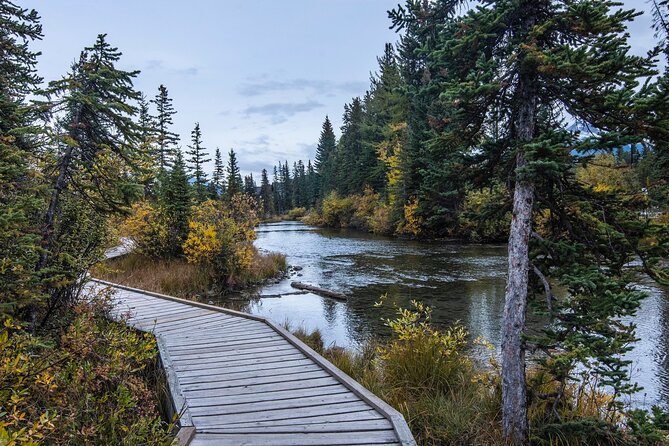
Stop 9 gives you the longer walk, around 10 minutes on Policeman’s Creek Boardwalk. The audio points out elements tied to the Bow River, the Canmore Nordic Centre, and festivals and events.
This part works because it shifts you from point-to-point listening into a slower, nature-forward stroll. If you want a breathing space in the tour, this is it.
Stops 11 to 15: Isabelle Dube, Canmore Museum, Japanese friendship, and Main Street
Isabelle Dube mural at 719 10 Street
Stop 11 is at 719 10 St. You’ll see a mural of Isabelle Dube and hear the tragic story behind it.
This is an emotional pivot in the route. The stop isn’t long, but it changes the tone of the tour from light and playful to something heavier. If you tend to prefer cheerful stories, just be mentally ready for this moment.
Canmore Museum and Geoscience Center
Stop 12 is the Canmore Museum and Geoscience Center. The tour points out that it has over 10,000 artifacts and has welcomed visitors since 1984.
Admission is not included. So think of this as a “stand outside or enter if you want” stop. Even if you skip paying, it’s still valuable for context. If you love geology and artifacts, this is a spot where you might extend your time.
Friendship Park and Higashikawa
Stop 13 is Friendship Park, where you learn what Canmore has in common with the Japanese city of Higashikawa.
This is one of those quick stops that can spark curiosity for the rest of your trip. It turns town parks into signals of connection, not just scenery.
Main Street shopping at 8 Avenue and 6 Street
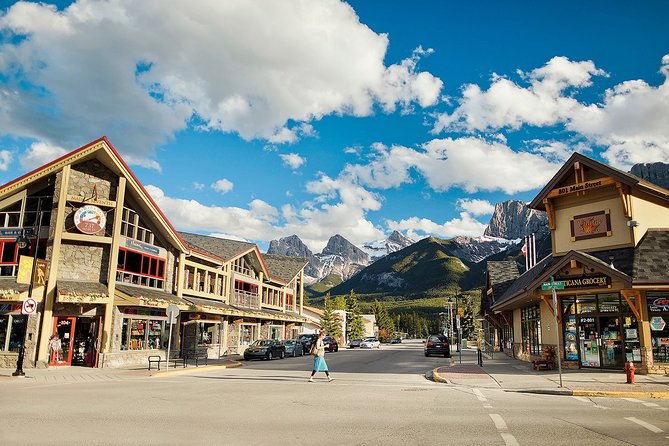
Stop 14 sends you down Main Street at 8 Avenue and 6 Street. The audio points out shops, restaurants, and galleries that call Canmore home.
This is a helpful moment because it tells you where to spend time if you want to break from the tour pace. It’s also where the tour quietly becomes a practical guide for your next hour.
Canmore Inn & Suites, built in 1890
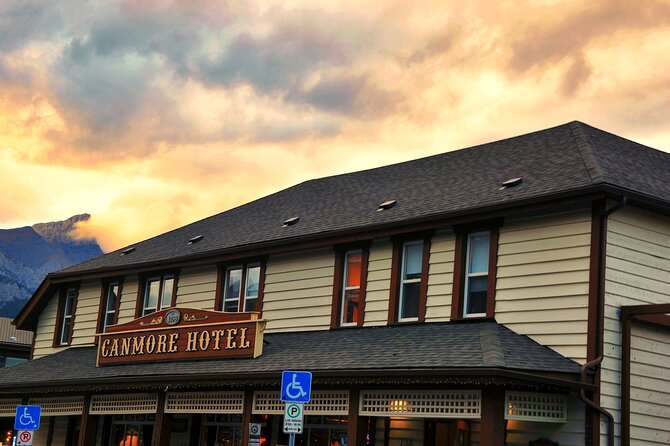
Stop 15 highlights the Canmore Inn & Suites, built in 1890 by Count Eugene de Rambouville.
This is where the tour gives you a sense of how long people have been building and living here. If you look at old hotels like this as “just a building,” you might miss the value. With the audio context, you see it as a landmark tied to the town’s timeline.
Stops 16 to 20: miners, policing, a church, Centennial Park, and the Big Head
Miners’ Union Hall and the tough relationship
Stop 16 brings you to The Canmore Miners’ Union Hall. You’ll learn about an important cultural and historical building and about the often contentious relationship between the town and miners.
This stop matters because it explains conflict, not just achievements. It’s a reminder that communities form through negotiation, not only through progress stories.
Ralph Connor Memorial United Church
Stop 18 is Ralph Connor Memorial United Church Canmore. The tour points out this early Presbyterian church built in Alberta and shares a mystery behind its name.
You don’t need to be religious to enjoy this. You just need to like local stories, names, and why buildings end up with the labels they do.
NWMP Barracks and maintaining law and order
Stop 19 is NWMP Barracks. The audio explains how the barracks played an important role in maintaining law and order in Canmore’s rough-and-tumble days.
If you’re the kind of person who likes history that sounds like it could be a movie scene, this is your stop. It gives the town’s early edge a framework.
Centennial Park, Three Sisters views, and events
Stop 17 is Centennial Park and is another longer stop at around 10 minutes. The audio highlights three things: views of the Three Sisters Mountains, the Stan Rogers stage, and annual events and festivals that take place there.
This is a great place to slow down. It’s where the town’s identity comes together visually and socially, even if you’re just passing through on a random afternoon.
Big Head Sculpture, and why it shaped the town’s name
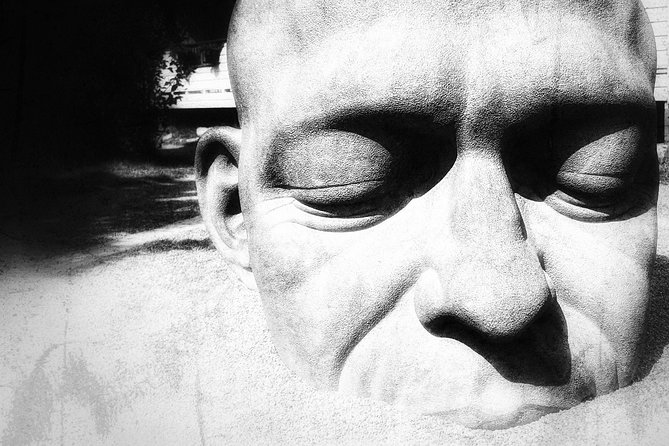
Stop 20 finishes at the Big Head Sculpture. The tour explains the odd sculpture and how it’s associated with Canmore itself.
Finishing on this note is smart. It turns the final stop into a punchline with meaning. You’ve learned the coal and the rules, the streets and the sculptures, then you end with a quirky landmark that ties the whole experience together.
How to make the walk feel like your own day
I’d treat this tour as a flexible checklist, not a fixed script. Since the audio plays when you arrive near each point, you can pause for photos or take a snack break without messing up the flow.
For the best experience:
- Download the tour on Wi-Fi before you leave, then keep your phone battery in mind.
- Wear shoes that handle sidewalks and boardwalk sections comfortably.
- Plan for at least one or two stops to run long. Policeman’s Creek Boardwalk and Centennial Park are the usual places where you’ll want extra time.
If you’re traveling with limited time, you can also use it as a “choose your favorites” route. Even if you don’t spend time inside Canmore Museum, the outside context still helps you understand the town’s story.
If you’re visiting with kids, the trivia game can be a big win. It’s optional, but the format fits how kids like to participate. For adults who enjoy history, it’s also a solid way to understand coal mining, local conflict, and the influence of the railway without committing to a museum ticket.
Who this tour suits best (and who might skip it)
This is a good fit if you:
- like walking at your pace,
- want a guided story layer without a live group leader,
- enjoy town history, public art, and mountain-name context,
- want a budget activity that still feels like a proper experience.
You might prefer a different style if you:
- hate using your phone for navigation and audio (even with GPS, it’s still screen-based),
- need a completely museum-heavy day (because some stops can involve places with separate admission),
- want long guided stops where you sit and listen for extended periods (most stops are short and photo-friendly).
Should you book this smartphone audio tour?
Yes, if you want an efficient, low-stress way to understand Canmore beyond the obvious views. The live GPS, the auto-playing audio, and the playful trivia game make it more than a list of landmarks.
Book it especially if you’re the type who likes walking a loop, learning a bit at every stop, and finishing with a better sense of the town’s coal mining past and mountain-name stories. If you’re unsure, just remember the main tradeoff: some cultural stops, like the Canmore Museum, can involve separate admission.
Recently listed around Canmore
- 2 Day Banff Lake Louise Johnston Canyon Gondola Cave Basin tour★ 4.5 · 8 reviews
- Private Tour: Majestic Mountains PHOTO SAFARI Drive – 4H★ 5.0 · 4 reviews
- Rocky mountain – VIP Experience – Private Boat★ 5.0 · 6 reviews
- Guided E-Bike Tour of Canmore★ 5.0 · 17 reviews
- Yoho National Park: Emerald Lake and Takakkaw Falls★ 5.0 · 4 reviews
- Sunrise Adventure: Alpenglow at Moraine Lake & Lake Louise★ 5.0 · 20 reviews
- Experience Golden Hour at Moraine and Lake Louise★ 5.0 · 18 reviews
- Sunset at Moraine Lake & Stargazing Tour from Canmore/Banff★ 5.0 · 95 reviews
Walking Tours, compared.

Old Quebec City: Grand Walking Tour with Private Option
Read our review →
The Original Old Montréal Walking Tour by Guidatour
Read our review →
Old Montreal Small-Group Walking Tour | Max 10 | by MTL Detours
Read our review →
Old Quebec Classique Walking Tour with Funicular
Read our review →

Quebec: Crimes of New France Animated Walking Tour
Read our review →Browse the lists this tour appears in