
REVIEW · WALKING TOURS
Private Jewish Walking Tours in Toronto
Jewish Toronto reads like street-level theater. This private 2-hour walk threads together immigration stories, synagogue architecture, and the changing feel of neighborhoods, all without turning it into a museum lecture. You start at the Art Gallery of Ontario area and end in Kensington, where you can keep wandering after the tour.
What I love most is the detail-per-minute approach, with short stops that still explain why a place mattered. The route moves through key addresses like Beverley Street, Henry Street, and Cecil Street, then finishes at the Minsker Synagogue on St Andrew. I also like that the tour is built for real walking, so the “what happened here” story stays attached to what you can see now.
One consideration: it is history-forward. If you want a lot about today’s Jewish community in Toronto, you may need to top that up with independent reading or a separate visit, because the emphasis is on earlier waves, institutions, and buildings.
In This Review
- Key highlights you should not miss
- Why this Toronto walk works (even if you are not a history buff)
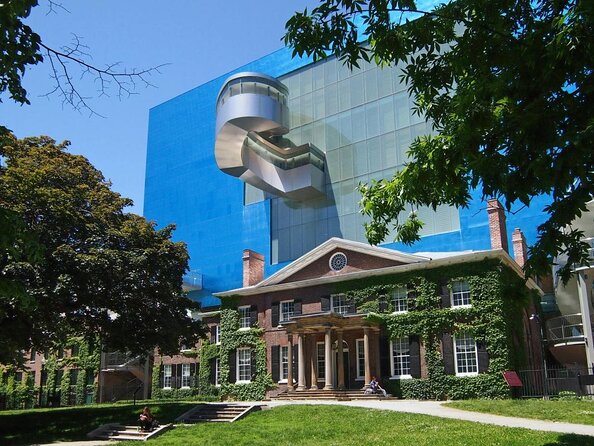
- Getting oriented at the Art Gallery of Ontario (AGO)
- Beverley Street: immigration, neighborhood character, and policy reactions
- George Brown House and the public-school connection
- Walking toward Henry Street: the commercial history bridge
- 23 Henry St: synagogue architecture and a big emotional payoff
- Cecil Street: Toronto’s institutional hub and Labour Zionist life
- Spadina Avenue: from cowboys to Yiddish theatre and food culture
- Finishing at Kensington Market, plus the Minsker Synagogue on St Andrew St
- Price and value: is $41.16 per person worth it?
- Who should book this tour, and who might want a different option
- Practical tips for making the most of your 2-hour walk
- Should you book Private Jewish Walking Tours in Toronto?
- FAQ
- How long is the tour?
- What is the price per person?
- Is this tour private?
- Where does the tour start and end?
- What language is the tour offered in?
- Is admission included for the Art Gallery of Ontario stop?
- Is admission included for the other stops?
- What should I expect the weather to be like?
- How far in advance is it usually booked?
- Is there a cancellation option if plans change?
- Are service animals allowed?
Key highlights you should not miss
- Art Gallery of Ontario as the starting lens, using early immigration history to frame what you will see next
- Beverley Street addresses that track policy and community response, then pivot to neighborhood institutions
- Henry Street synagogue turned Holy Trinity Russian Orthodox Church, including synagogue architecture and a memorable sense of place
- Cecil Street as Toronto’s institutional hub, with a tour through Labour Zionist life and other organizations on one of the key streets
- Spadina Avenue’s two sides of community life, from less traditional areas to Yiddish theatre and food shops
- Kensington Market finish at the Minsker Synagogue, where St Andrew St feels like a compact “neighborhood in miniature”
Why this Toronto walk works (even if you are not a history buff)
This tour is the kind that makes you look up from your phone and actually notice the street. Instead of asking you to memorize dates, it connects big events to very specific locations: named buildings, street corners, and blocks you can walk again after the tour ends.
You also get a smooth sense of progression. Early history sets the tone, then the route shifts from arrival and settlement to institutions, worship spaces, and community organizations. By the time you reach Kensington, the story has changed gears into something more textured, including the more commercial, less straight-laced side of neighborhood life.
And because it is a private format, you are not stuck in a slow-moving group shuffle. Your guide can pace the conversation. If something catches your eye, you are more likely to get a clear answer without the “tour conveyor belt” feeling.
The duration, about 2 hours, matters too. You can fit this on a busy day in Toronto, and you still have time to make your own plans afterward in the Kensington Market area where the tour concludes.
More Walking Tours in Toronto
- Show me the City! A Small Group Walking Tour of Toronto
★ 5.0 · 621 reviews - Toronto Distillery District Walking Tour
★ 5.0 · 327 reviews - Toronto: City Highlights Walking Tour | 3-Hour
★ 4.6 · 306 reviews
Getting oriented at the Art Gallery of Ontario (AGO)
The walk begins at the Art Gallery of Ontario, at 317 Dundas St W. You spend about 10 minutes here, and the point is not to turn the tour into an art stop. It is a historical opener, covering the early history of Toronto’s Jewish community through the mass immigration of the late 19th and early 20th centuries.
What I like about this setup is that it gives you a lens. When you later stand on streets like Beverley Street and Henry Street, you can link the visuals to a bigger story: people arriving, forming communities, then building institutions that expressed both identity and practical needs.
Note the practical detail: an AGO admission ticket is not included. So you should think of this first stop as orientation and context, not a guaranteed museum visit. If you want to go deeper into galleries, plan that separately, before or after.
Even if you only absorb the “why” behind the neighborhood changes, this opening helps. It also makes the whole tour feel less random, because the route is clearly answering one question: how did Toronto’s Jewish life take shape where it did?
Beverley Street: immigration, neighborhood character, and policy reactions
After the AGO framing, you shift into street-level storytelling. The tour moves along Beverley Street with a series of short stops, each one adding a different layer.
At 136 Beverley St, you get about 7 minutes focused on how the neighborhood’s character formed, and how Jewish institutions helped absorb immigrants. The idea here is not just settlement in the abstract. You are watching the community become local infrastructure, with buildings and services that made life more stable.
Then comes 147 Beverley St, around 3 minutes, where the narrative turns to government immigration policies and Jewish reaction to them. Even in a short time, this stop matters because it shows that the story was not only about hope and community. It was also about external pressure, changing rules, and how people responded.
From there, the route keeps the pace tight. 70 D’Arcy St, about 4 minutes, is tied to a former Eitz Chaim school, and it brings in the idea of colorful characters in the school’s past. Schools are often where communities reproduce themselves, and this stop suggests the human side of institution-building, not just architecture.
George Brown House and the public-school connection
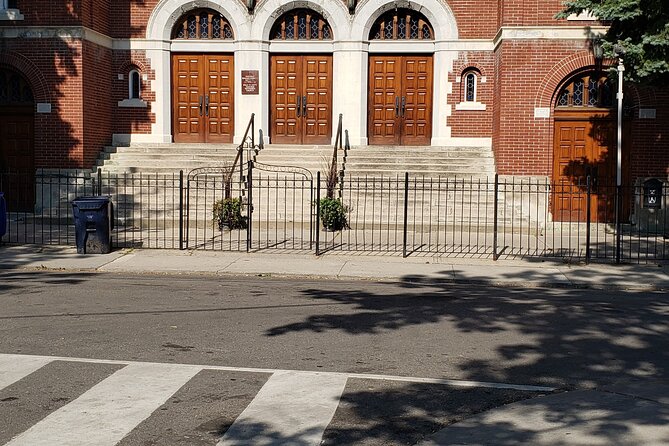
Next is 186 Beverley St, about 3 minutes, linked to the George Brown House. Here the tour adds a non-Jewish Canadian context, then brings it back to the Jewish history of the public school next door.
This is one of those spots that can easily feel like a tangent, but it is actually useful. It nudges you to notice that immigrant and minority communities did not develop in a vacuum. Public institutions, mainstream Canadian structures, and Jewish neighborhood life all overlapped in real ways.
If you like tours that connect “what happened” to “how society worked,” this stop delivers a quick reality check. Toronto was not a set of isolated enclaves. It was a working city where communities had to interact with larger systems, including schooling.
A few more Toronto days to compare
- Old Town Toronto Highlights 3 Hour Walking Tour | Gratuity-Based
★ 4.5 · 290 reviews - Toronto: Dark History Nighttime Walking Tour
★ 4.7 · 273 reviews - Toronto: Distillery District Historic Walking Tour
★ 4.8 · 267 reviews - Ghost Tour of Toronto Original Haunted Walk
★ 4.5 · 185 reviews
Walking toward Henry Street: the commercial history bridge
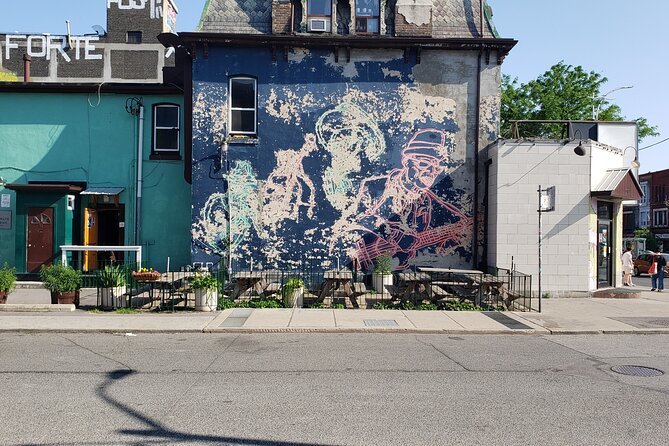
Between the Beverley area and Henry Street, the tour includes time to learn interesting details about the commercial history of the street as you walk through to Henry St. This might sound like filler, but it is often what makes the neighborhood story believable.
Commerce is where communities become visible to everyone else. It is also where you can often track change faster than you can through official records. Even a simple shift from one kind of storefront to another can reflect demographic shifts, economic survival, and changing cultural rhythms.
So treat this as a setup moment. It helps you understand why later synagogue locations sit inside lively streets, not behind museum walls.
23 Henry St: synagogue architecture and a big emotional payoff
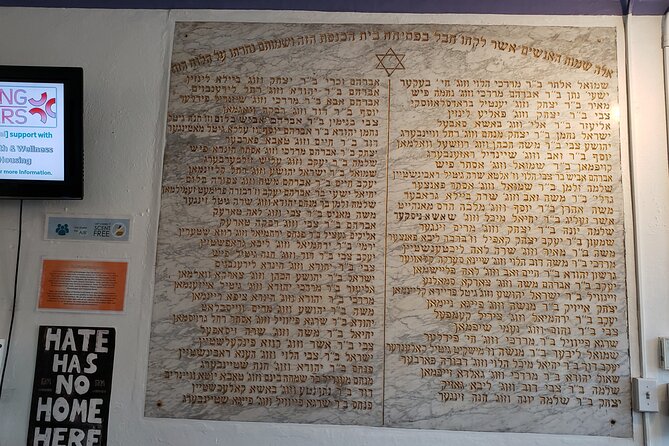
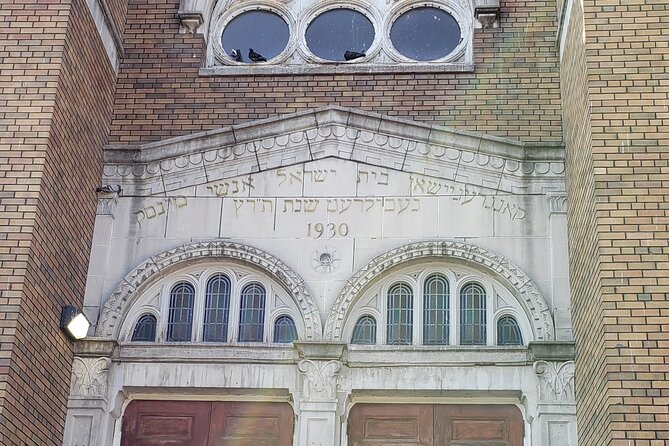
The Henry Street stop is one you will remember. At 23 Henry St, you visit Holy Trinity Russian Orthodox Church, formerly the Henry Street synagogue, with about 10 minutes here.
This is where the tour moves from institutions-as-concept to institutions-as-building. You look at synagogue architecture, plus the early synagogues and Toronto’s first Jewish architects. Even if you do not know architectural terms, you can still see how the design choices signal identity and community priorities.
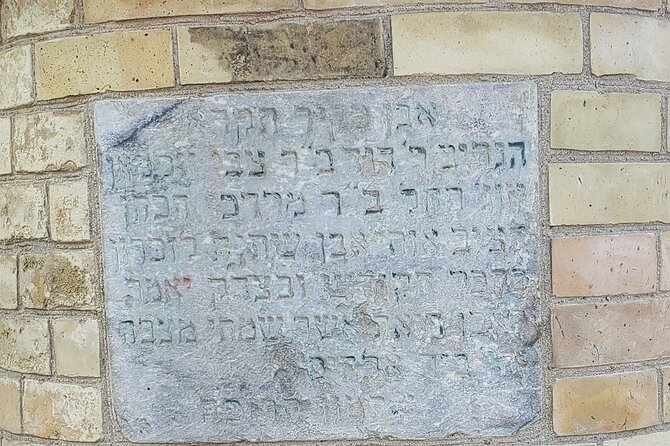
One detail that tends to stick is the sense of continuity you get from the building’s earlier life. In at least one case from the shared tour experience, people highlight an original wall of names connected to the old synagogue. That kind of physical artifact can turn a history talk into something much more personal.
If you are the type who likes a story with heart, this is the stop where the tour earns it. It also works as a reminder that religious buildings often outlive the communities that first built them, but not without leaving traces.
Cecil Street: Toronto’s institutional hub and Labour Zionist life
Cecil Street is where the tour starts to feel like a map of Jewish civic life. You spend about 24 minutes in this area, including a run-through of different addresses and organizations tied to older Jewish community life.
The tour includes points on and around 206 and 207 Beverley, used to introduce Cecil Street as the institutional hub of the older Jewish community. Then you move onto 24 Cecil Street, described as Labour Zionist HQ and school, with later political history covered as well.
A bigger sweep follows at 33-58 Cecil Street, where you get an overview of Jewish organizations and institutions once housed there. This is the “how communities organized themselves” section of the walk, and it matters because it shows what Jewish institutional life looked like beyond worship.
The Cecil Street Community Centre also enters the story, described as a building with a past as a synagogue and a centre of traditional entertainment. That combination, worship plus community gathering plus culture, is a powerful reminder that these spaces were not only about religious rituals. They were about social life, education, and keeping culture going.
If you care about how minority communities build networks, Cecil Street is one of the best sections of the route.
Spadina Avenue: from cowboys to Yiddish theatre and food culture
After Cecil Street, the tour shifts to Spadina Avenue for about 26 minutes, and it becomes more layered and, frankly, more fun.
You get a northbound segment from Cecil St to the El Mocambo, described as a less traditional side of the neighborhood. The story includes Spadina cowboys from the 1930s and 1940s. This is a great reminder that neighborhoods are never single-identity spaces. They change with the city around them.
Heading back southbound toward Cecil Street, you connect to Grossman’s Tavern, plus the commercial development of the street and the Spadina music scene. The take here is clear: Jewish Toronto did not only live in synagogues and schools. It also lived in leisure, nightlife, and everyday business.
Then the route pivots again, looking at Spadina west side at Baldwin Street, where Kensington is explained as a market. This is an especially useful lens if you are heading into Kensington Market afterward, because you start to see why the market exists in the first place.
The tour also highlights Spadina between Dundas and St Andrew, including Yiddish theatre, delis, dairy restaurants, and the history of the hat trick. Even if you only remember a couple of those details, they help you understand why the area’s food and entertainment culture feels so story-rich today.
Finishing at Kensington Market, plus the Minsker Synagogue on St Andrew St
The tour ends at 57 Kensington Ave, with the conclusion at the corner of Kensington Ave and St Andrew St. Your last stop is at 10 St Andrew St, about 5 minutes, at the Minsker Synagogue.
This ending matters because the route closes in a neighborhood where you can keep experiencing the city’s layering. St Andrew St gets described as the neighborhood in miniature, with the Labour Lyceum across the street also referenced. You also hear the history of the synagogue and that it was the first in the Kensington area.
What makes this a strong finish is the contrast. You started with early immigration context, moved through institutions and architecture, then ended where the city’s daily life is tangible. After the tour, you have an easy next step: wander Kensington Market streets while the story is still fresh.
Price and value: is $41.16 per person worth it?
At $41.16 per person, you are paying for a focused, guided walk that turns a handful of streets into a connected narrative. In Toronto, where self-guided exploring can easily become “read signage and hope for the best,” paying for a guide is how you get the links between places.
The private format adds value too, because the tour can stay adaptive to your pace and your questions. And since it is about 2 hours, you are not buying half a day and then feeling like you missed something else.
You also get a few practical perks that help the experience stay smooth: a mobile ticket, the tour offered in English, and it is near public transportation. Service animals are allowed as well.
If you are the kind of visitor who likes to understand a neighborhood’s logic, the price starts to feel like a fair exchange for time saved and context gained. You are not just walking. You are learning how these buildings and streets fit together.
Who should book this tour, and who might want a different option
This tour is a great match if you want:
- Street-level storytelling that connects Jewish life to specific Toronto addresses
- A clear sense of how immigration, institutions, and community organization shaped neighborhoods
- An ending that naturally pairs with exploring Kensington Market
It may feel less ideal if:
- You expect a heavy emphasis on the Jewish community as it exists today in Toronto. The emphasis here is primarily on earlier eras and the buildings that carry those eras
- You want lots of indoor time or museum-style exploration. Most of the tour is walking and short stops, and even the AGO start is brief and does not include admission
If your ideal tour is “short stops with clear explanations,” you will likely enjoy the pacing.
Practical tips for making the most of your 2-hour walk
Plan for good walking shoes. Most of the experience is outdoors and at street corners, so your comfort directly affects how much you absorb.
Dress for the weather, because the tour depends on good weather. If conditions are poor, you may be offered a different date or a full refund.
Because it is about 2 hours, I suggest you keep your next stop flexible. You will finish in Kensington Market, and it is a good idea not to schedule something that forces you to rush right away.
Also, since the tour is in English and runs as a private group, it is smart to come with at least one or two questions. For example, ask how the story shifts between places of worship, schools, and community organizations. That helps you get more out of the stop sequence.
Finally, note that the AGO admission is not included. If you are curious about the gallery itself, treat this start as context, not a complete museum detour.
Should you book Private Jewish Walking Tours in Toronto?
Yes, if you want a compact, coherent way to understand Jewish Toronto through streets and surviving buildings. The tour’s biggest strength is how it links immigration and policy, then moves into institutions, synagogue architecture, and the community spaces that shaped everyday life.
Book it when you like to walk, read the city, and come away with a neighborhood map in your head, not just a few photos on your camera roll. If your priority is today’s scene rather than the older built landscape, pair it with your own extra time in the area or a separate visit focused on contemporary community life.
If you are balancing value, time, and real specificity, this one hits a sweet spot for Toronto.
FAQ
How long is the tour?
The tour lasts about 2 hours.
What is the price per person?
The price is $41.16 per person.
Is this tour private?
Yes. It is listed as a private tour/activity, so only your group participates.
Where does the tour start and end?
It starts at the Art Gallery of Ontario, 317 Dundas St W, Toronto, ON. It ends at 57 Kensington Ave, in the heart of Kensington Market at the corner of Kensington Ave and St Andrew St.
What language is the tour offered in?
The tour is offered in English.
Is admission included for the Art Gallery of Ontario stop?
No. Admission ticket for the Art Gallery of Ontario stop is not included.
Is admission included for the other stops?
Admission is listed as free for the stops at the addresses along the route.
What should I expect the weather to be like?
The experience requires good weather. If it is canceled due to poor weather, you will be offered a different date or a full refund.
How far in advance is it usually booked?
On average, it is booked about 21 days in advance.
Is there a cancellation option if plans change?
You can cancel for free up to 24 hours before the experience start time for a full refund. If you cancel less than 24 hours before, the amount paid is not refunded.
Are service animals allowed?
Yes, service animals are allowed.
Recently listed around Toronto
- All-Inclusive Camp & Tube At Elora Gorge (2 Day)★ 5.0 · 4 reviews
- Canada eSIM | 3-30 days | Daily data | QR code★ 4.0 · 12 reviews
- Toronto Craft Brewery Tour★ 5.0 · 97 reviews
- Handcrafted Donuts of Toronto: A Sweet City Walking Tour★ 5.0 · 141 reviews
- Underground Toronto PATH Tour★ 4.5 · 6 reviews
- Pottery wheel class in Toronto Bay&Dundas★ 4.5 · 5 reviews
- Tour to Niagara Falls from Toronto★ 4.0 · 19 reviews
- Roundtrip Private Transfer from Toronto Airport (YYZ)★ 5.0 · 3 reviews
Walking Tours, compared.
Old Quebec City: Grand Walking Tour with Private Option
Read our review →
The Original Old Montréal Walking Tour by Guidatour
Read our review →
Old Montreal Small-Group Walking Tour | Max 10 | by MTL Detours
Read our review →
Old Quebec Classique Walking Tour with Funicular
Read our review →
Quebec: Crimes of New France Animated Walking Tour
Read our review →Browse the lists this tour appears in