

REVIEW · HISTORICAL TOURS
Historic Saint John Smartphone Audio Walking Tour
Saint John tells its story, stop by stop. This smartphone audio walk uses live GPS so the narration starts when you arrive, taking you through Uptown highlights at your own pace. I like that you do the exploring, not the scheduling.
Live GPS and auto-playing audio make the route feel clear and low-stress, even if you are new to Saint John.
I also love the way it is offline-ready. Download on Wi-Fi first, then the tour keeps going without needing signal or mobile data. The result is a comfortable 1.5 to 2 hour loop that works well on a day when you want flexibility.
One consideration, the walk includes some hills, so wear shoes you trust.
In This Review
- Key things that make this tour worth your time
- Starting at the cruise terminal, with GPS that tells you where to stand
- How to prep your phone so the audio works smoothly
- Port to container village: the waterfront angle you actually feel
- Civic plaza and the Bay of Fundy secret behind the buildings
- Loyalists and Fort La Tour: the story turns personal
- The Great Fire of 1877, then the city rebuilds in stone
- Arts Centre and old churches: Beaux-Arts elegance and Loyalist faith
- Farmers’ market and King’s Square: daily life beside old conflicts
- Court house, fire museum, and the theater that survived almost everything
- Trinity Anglican Church and the Boston coat of arms story
- Domville Building, policing stories, and the Police Museum
- Saint John High School and Stoneleigh Terrace, ending with maritime navigation cues
- Price and value for an audio walk at about $9
- Pacing tips for a walk that includes hills
- Who this tour fits best
- FAQ
- How long is the Historic Saint John smartphone audio walking tour?
- Where do I start this tour?
- Is there a live GPS map during the walk?
- Does the tour use mobile data while I am walking?
- Do I need headphones?
- Is this tour only offered in English?
- Is it a group tour with other people?
- What if the attractions are closed when I get there?
- What physical condition do I need?
- When can I start the tour?
- Can I cancel for a refund?
- Should you book this Historic Saint John smartphone audio walking tour?
Key things that make this tour worth your time

- GPS-triggered audio keeps you oriented and reduces map-checking.
- Download on Wi-Fi first means you can walk without signal or data.
- Loyalist stories connect multiple stops, from churches to homes to burial grounds.
- Big events are made human, especially Fort La Tour and the Great Fire of 1877.
- Local culture is built in, including Area 506 and Canada’s oldest continuously operated farmers market.
- No hard time limit lets you pause for photos, snacks, and browsing.
Starting at the cruise terminal, with GPS that tells you where to stand

You begin at the Marco Polo Cruise Terminal, 111 Water St, Saint John. That’s a smart setup because it drops you near the action, and it is easy to reach by public transit. Your tour ends right back at the meeting point, so you do not have to figure out a return plan.
Before you go, plan for the audio to be ready. The tour is designed so you download on Wi-Fi beforehand, and then during the walk there is no signal required and no data used. You will also see a live GPS map showing your route and your location, which makes the whole experience feel more like guided wandering than guesswork.
A few more Saint John days to compare
- Pete’s Historic Walking Tour
★ 5.0 · 321 reviews - Saint John Walking Tour
★ 4.5 · 39 reviews - Saint John Walking Tour
★ 3.9 · 7 reviews
How to prep your phone so the audio works smoothly
Headphones are optional. If you do not use them, the audio plays through your device speaker, which is fine for most streets but less ideal if you are near other people. Either way, your best move is to bring a fully charged phone, and keep your brightness reasonable so you can read the map when you need it.
You will also want to download before you leave Wi-Fi range. That tiny step makes a big difference in how relaxed your walk feels. Since the audio automatically plays at each point of interest, you spend less time staring at your screen and more time looking up at what is around you.
Port to container village: the waterfront angle you actually feel
The first story spot focuses on Saint John’s role as the third-largest port in the Maritimes. You are meant to look at the flow of cargo ships and cruise liners, then connect that activity to centuries of trade and immigration. This is one of those starts that sets a tone, the city did not grow by accident, it grew because goods and people kept moving.
Next comes Area 506 Waterfront Container Village. Instead of treating it as just a place to shop, the tour nudges you to notice how the businesses live inside repurposed shipping containers. You can browse local art, crafts, and food, and you also get a stop tied to the Graffiti Alley, with murals by artists from around the world. If you like street-level creativity, this part is the palate cleanser between major landmarks.
From the waterfront world to a single architectural moment: Furlong’s Liquor Store. The audio includes special guest segments, and the focus is the building’s details, including intricately carved marble columns and whimsical gargoyles. The narration plays with an idea the carvings were meant to hint at treasures within. Even if you do not buy anything, it is still a fun reason to look closely at stonework you might otherwise walk past.
Civic plaza and the Bay of Fundy secret behind the buildings

After Furlong’s, the tour moves into a civic plaza that has served as a gathering place for thousands of years. You learn how it changed from a commercial port and a parking lot into a community hub. I like stops like this because they show the city as something people use day to day, not just something people photograph.
Then you get a darker, more hidden layer. The audio points you beyond the modern patios and facades to remnants of warehouses from the mid-1800s. It also brings in a strange detail about how the Bay of Fundy tides once affected ships trying to moor there. That is the kind of practical history that makes the waterfront feel real, not just scenic.
A different day out in Canada:
- Hopewell Rocks Admission
★ 4.5 · 343 reviews - Bay of Fundy Tour by Bus
★ 4.0 · 211 reviews - Go Fundy Tours
★ 5.0 · 171 reviews - Fundy Coast to Fundy Shore Tour
★ 4.0 · 82 reviews
Loyalists and Fort La Tour: the story turns personal

Now the narrative focuses on 1784 and the arrival of thousands of Loyalist refugees after fleeing persecution during the American Revolution. This stop matters because it helps you understand why multiple parts of Saint John, especially churches and civic spaces, feel shaped by community memory.
Then you step into one of the most dramatic segments in the walk: Fort La Tour. The audio tells the harrowing story of Françoise Marie Jacqueline, known as the Lioness of La Tour. You hear her story in her own words, centered on her brave defense of the fort and her ultimate sacrifice. This is not just a list of dates, it is built to make you imagine what leadership and fear looked like at that moment.
The Great Fire of 1877, then the city rebuilds in stone

From Fort La Tour the tour jumps to the Great Fire of 1877. You end up surrounded by brick and stone buildings that function like monuments to what happened. The narration ties together how Saint John rebuilt and created a more fire-resistant city, which helps you see the architecture as something born from survival.
As you walk, look for smaller clues of that resilience. Chipman Hill Suites is one of the stops that adds a human twist, with a story about one of the first residents, a woman who defied social norms. If you are interested in how everyday people challenged expectations, this is a great break from the big-event theme.
Arts Centre and old churches: Beaux-Arts elegance and Loyalist faith

Next you reach the Saint John Arts Centre, notable for its French Beaux-Arts architecture. The tour explains that it was originally built as a public library and has since become a cultural hub. Even if you only peek at the exterior, the point is clear, the city repurposes important civic buildings instead of letting them vanish.
Then it is on to Saint John’s Anglican Church, described as the oldest surviving stone church in the city. The audio connects its significance to the Loyalists and to community resilience. Pay attention to how the tour keeps tying people to places, it is easy to enjoy the architecture, but the stories give you a reason to care.
You also pass a Federalist-style home with a secret from the American Revolution. The tour focuses on the family that built it and the architectural choices that helped it stand for centuries. I like these kinds of stops because they show how history can hide inside ordinary streets, you only notice it if someone tells you what to look for.
Farmers’ market and King’s Square: daily life beside old conflicts
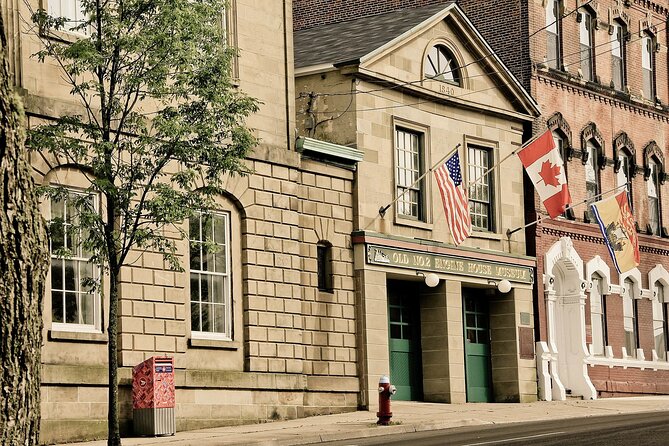
The tour highlights Canada’s oldest continuously operated farmers’ market. A special guest explains the secret behind the building’s unique inverted ship’s hull roof. Even if you just imagine the shape, it is a clever way to tie maritime design to local food life.
After that, you step into King’s Square, a historic green space with a past that included public punishment and civic unrest. The narration points out monuments that carry secrets of sacrifice and honor. This is one of those stops where your mood can change fast, from market energy to something heavier and more reflective, then back again as you keep walking.
The next chapter is quieter: the Loyalist Burial Grounds. You hear from one of its first residents, a Loyalist who fled the American Revolution. The audio also explains how the final resting place has been transformed into a peaceful park. If you like spaces that let you slow down, this segment gives you the chance.
Court house, fire museum, and the theater that survived almost everything
Two major civic buildings follow. The Saint John County Court House is introduced as elegant but with a dark past, including some of the city’s most infamous trials. Next door is the Fire House Museum, described as surviving two of the city’s worst fires. Together, these stops form a strong one-two punch, justice and catastrophe, then the persistence of institutions.
Then you head to the Imperial Theatre, built in 1912 and restored after being nearly demolished. The audio covers its past as a vaudeville and film house, and it includes the story of how it was saved by a local taxi driver. That anecdote is exactly the kind of “only-in-this-city” detail that makes a self-guided tour feel more alive.
The tour continues to the Admiral Beatty Hotel, once a luxury hotel with suites reserved for royalty. You also hear about notable figures who stayed there. This stop works best if you let your imagination play, because the building’s role as a status symbol connects back to the port and all the movement that brought visitors in.
Trinity Anglican Church and the Boston coat of arms story
After the hotel, the tour takes you to Trinity Anglican Church, which was rebuilt after the Great Fire of 1877. One of the most intriguing audio moments is about a salvaged artifact, a wooden Coat of Arms from the Boston State House. The tour includes the story of how the church wardens gave a cheeky reply when Boston asked for it back.
The audio also asks you to time travel for a second, if you were standing there on June 21st, 1877, you would be surrounded by the charred remains of a city flattened by the Great Fire. That kind of framing turns bricks and arches into a scene you can almost feel.
You then get pointed attention at the church’s grand entrance, described as a Gothic Revival masterpiece. The tour also includes a stop for a stone structure built in 1904, featuring Greek architectural elements, noted as one of three banks in the area. It is a reminder that Saint John’s rebuild was not only about surviving fires, it was also about creating a confident civic look.
Domville Building, policing stories, and the Police Museum
The tour continues to the Domville Building, built in 1878. Here, another special guest segment shifts the theme to policing, including what policing was like in the 1890s. You can also visit the Police Museum next door.
There is another moment of narration focused on a special guest and her vision for the building. Since the details of that vision are handled in the audio, you will know what to focus on once you reach the spot. For me, this is where the tour becomes most “walk and learn,” because you are not just viewing history, you are absorbing how it was lived.
Saint John High School and Stoneleigh Terrace, ending with maritime navigation cues
Near the finish, you reach Saint John High School, described as the oldest publicly funded school in Canada. The audio explains how it evolved from segregated schools for boys and girls into a modern, inclusive school known for strong academics. This is a meaningful stop because it shows change over time, not just survival after disasters.
Finally, you end at Stoneleigh Terrace, a row of homes that have stood for over 130 years overlooking the bay. The narration explains how lights from this place once helped captains navigate the port. Today, those lights serve as a beloved monument, which makes a satisfying landing, you end on a reminder that the sea shaped daily decisions long before your footsteps ever did.
Price and value for an audio walk at about $9
At $8.96 per person, this is priced for people who want structure without paying for a full guided group. The value is not just the number of stops. It is the way the tour is built to run smoothly: mobile ticket, downloadable audio, live GPS map, and automatic playback at each point of interest.
Also, you get flexibility. The tour has flexible dates, and once you start it, there are no time constraints, so you can take breaks without feeling like you are falling behind. For a city day where you want to cover a lot but not sit in a van for two hours, it is a practical buy.
Pacing tips for a walk that includes hills
You should plan for moderate physical fitness, and yes, the tour includes some hills. The good news is that it is self-paced. If you notice your phone battery dropping, pause somewhere safe, take a breath, and let audio catch up while you recharge.
Because headphones are optional, decide early how you want to experience it. If you want full clarity, bring basic earbuds. If you want to chat with your group, use the speaker and turn it down when you are near other people.
Finally, since recommended attractions can be closed or inaccessible due to season or circumstances beyond control, treat the walk as the main event. If you hit a closed stop, you still get plenty of story anchors from the surrounding landmarks.
Who this tour fits best
This works well if you like history that feels tied to real places, from ports and civic plazas to churches and markets. It also fits you if you travel in a group and prefer doing your own thing while still getting guided context.
If you hate hills, or you want a live human to adjust in real time, you may want to think twice. But if you are comfortable walking 1.5 to 2 hours and you appreciate stories that connect architecture to people, it is a strong option.
FAQ
How long is the Historic Saint John smartphone audio walking tour?
It takes about 1 hour 30 minutes to 2 hours to complete, and there are no time constraints, so you can take as long as you like.
Where do I start this tour?
You start at the Marco Polo Cruise Terminal, 111 Water St, Saint John, NB E2L 0B1, Canada.
Is there a live GPS map during the walk?
Yes. You get a live GPS map that shows your route and your location, and the audio plays automatically at each point of interest.
Does the tour use mobile data while I am walking?
No. You download on Wi-Fi before you go, and during the tour no data is used, even if you have no signal.
Do I need headphones?
Headphones are optional. Audio will play from your device speaker too, but headphones can help with clarity.
Is this tour only offered in English?
Yes, it is offered in English.
Is it a group tour with other people?
No. It is private, so only your group participates.
What if the attractions are closed when I get there?
The tour notes that some recommended attractions may be closed or inaccessible due to season or circumstances beyond control.
What physical condition do I need?
You should have a moderate physical fitness level, and the tour includes some hills.
When can I start the tour?
It is available daily within the operating window shown, and the listed hours are 12:00 AM to 11:30 PM.
Can I cancel for a refund?
Yes, you can cancel for free up to 24 hours in advance for a full refund.
Should you book this Historic Saint John smartphone audio walking tour?
Yes, if you want an affordable, structured way to cover Uptown Saint John with GPS-guided audio and no pressure to keep up with a group. It is especially appealing when you like a story arc, Loyalists, the Great Fire of 1877, and how the city rebuilt itself in stone and daily life.
Book it if you are comfortable with some hills and you will charge your phone and download the audio on Wi-Fi first. If those parts sound annoying, then a live guide might suit you better.
Recently listed around Saint John
- 3 different tours to choose from★ 5.0 · 23 reviews
- Shore Tours★ 4.5 · 33 reviews
- Private Sightseeing Tour In Saint John★ 4.0 · 6 reviews
- Shore Tours Saint John★ 5.0 · 4 reviews
- Saint John Walking Tour★ 4.5 · 39 reviews
- Introduction to Sailing in Saint John, NB★ 5.0 · 5 reviews
- Private Bay of Fundy & City sightseeing (Saint John, NB)★ 4.5 · 13 reviews
- Saint John Small Group Night Tour with Fort La Tour + Martello★ 4.5 · 6 reviews
Historical Tours, compared.



Evening Gourmet Tour 5 Course Dinner – History and Food in Old Quebec City
Read our review →


Browse the lists this tour appears in