

REVIEW · HISTORICAL TOURS
Half-Day Historical Tour of Halifax
A city can feel small until a guide connects the dots. This Halifax and Dartmouth half-day tour turns key waterfront and downtown stops into a clear story about shipping, wars, and everyday life, with Paul at the mic. I especially like the small-group size (max 10) and the way stops are chosen for both landmarks and meaning, not just photos. One thing to plan for: with so much packed in, you may spend more time in the van than you expect, especially on a busy cruise day.
What I really like is that the tour balances big events with local detail, from Pier 21 to the Halifax Explosion memorials. You also get a sensible flow: downtown first, then toward Dartmouth and Fisherman’s Cove. The main drawback is timing pressure for cruise departures, so bring a buffer and double-check where you’ll be dropped off and when.
In This Review
- Key things I’d mark on your map
- Hitting the ground running in Halifax
- Pier 21, the Farmers Market, and the start of Halifax’s story
- Dartmouth and Georges Island: where the harbor gets serious
- Beer, ships, and maritime memory
- Downtown heritage stops you can actually feel
- Cemeteries and the darker chapters of Halifax
- The Halifax Explosion Memorial Bell Tower, where the view hurts
- Lunch with a view, plus Dartmouth water and Fisherman’s Cove
- Price and time: deciding if 6 hours is the right fit
- Should you book this Halifax history tour?
- FAQ
- How long is the Half-Day Historical Tour of Halifax?
- What is the group size?
- Does the tour include pickup?
- What is included in the price?
- Is lunch included?
- Is the tour in English?
- Are any admission tickets included?
- What if the weather is bad?
- What is the cancellation window?
Key things I’d mark on your map

- Pier 21 as the Gateway to Canada, with context before you even hit the waterfront
- Georges Island’s layered story of defenses, tunnels, and the Acadian deportation era
- Halifax Explosion memorial sites, including the Bell Tower view over the devastated harbor
- Ship history you can walk past, like HMCS Sackville and the Titanic-linked threads
- Dartmouth finish in Fisherman’s Cove, a restored working village for easy, colorful photos
Hitting the ground running in Halifax
Halifax has a talent for doing two things at once: looking calm while its past was anything but. This tour leans into that contrast. You start early enough to beat some crowds, and you move through neighborhoods that most visitors only skim.
The van matters more than you’d think. It’s an air-conditioned Ford Transit 350 XLT high-roof with WiFi onboard, so you can settle in and focus on the guide’s explanations. Paul also uses multimedia support (slides and videos) to keep the history from turning into a blur of dates.
Because the group is capped at 10, the tour feels more personal than the typical bus circuit. You’re not lost in a herd, and that makes it easier to ask quick questions when something hits your interest.
A few more Halifax days to compare
- Peggy’s Cove & Halifax Historic Tour
★ 4.5 · 375 reviews - Halifax: Georges Island National Historic Site Ferry Ticket
★ 4.9 · 28 reviews - Victoria Guided Food and History Tour
★ 5.0 · 2,015 reviews
Pier 21, the Farmers Market, and the start of Halifax’s story
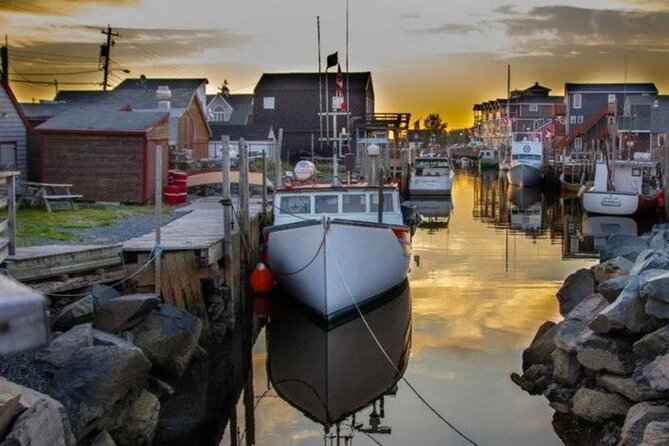
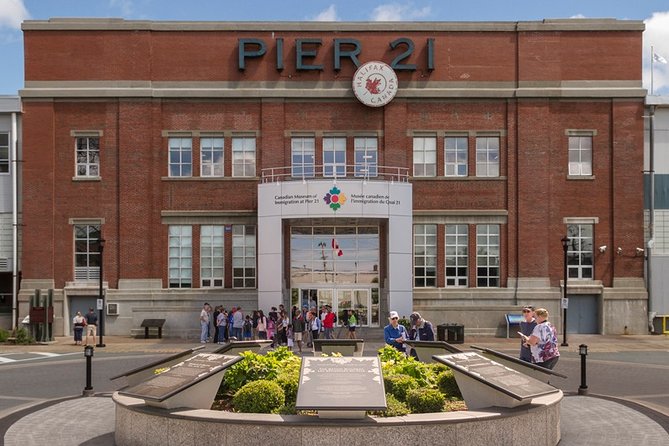
The first stop is Pier 21, often described as the Gateway to Canada. The value here is pacing. You hear what Pier 21 meant in the larger Canadian story before you wander the waterfront area later in the day. It helps the harbor feel less like a backdrop and more like the engine of local life.
Next comes the Halifax Farmers Market, and the details are the point. The market traces back to June 1750, a year after Halifax was founded. It was originally designated by the Governor and Council, and it sold everything from produce to livestock coming from Acadian farms in the Annapolis Valley and local production. Later, when the city was incorporated in 1848, the charter language emphasized public benefit.
Even if you don’t plan to buy anything, this stop gives you a solid sense of how Halifax worked day to day, not just in wartime headlines.
After that, you’ll see a piece of art tied to the immigrant experience. There’s a moving depiction of Armando Barbon stepping onto a ship with his wife Yole and their children, with an inscription about overcoming separation through faith and hope. It’s the kind of stop that quietly shifts the tour from “history facts” to “human history.”
Dartmouth and Georges Island: where the harbor gets serious
From downtown, the tour turns toward the harbor’s strategic side with Georges Island. This place is not just a pretty island you pass by in a photo. It was occupied by British forces in 1750 and became central to seaward defenses for a major naval station in the British Empire.
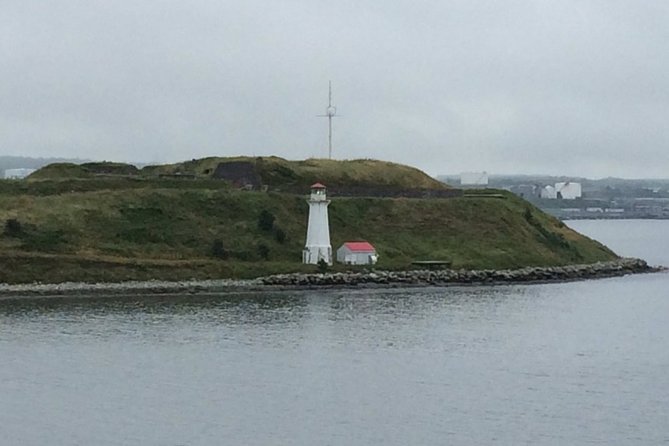
You’ll hear about Fort Charlotte, powerful seaward-facing batteries, and an underground tunnel complex. The island also includes one of Canada’s early fully automated lighthouses, which adds a quieter layer to the military story.
What makes Georges Island unforgettable is the way it holds multiple eras in one spot. It was also used as a prison in the early years, and between 1755 and 1763 it served as a holding area during the deportation of the Acadians, known as Le Grand Dérangement. The combination of subterranean passages and local folklore gives the island a haunted feel without needing theatrics.
If you’re the type who likes to understand why places look the way they do, this is one of the strongest segments of the day.
Beer, ships, and maritime memory

You’ll get a stop that points straight to Nova Scotia’s pride in craft brewing, Alexander Keith’s Nova Scotia Brewery. Keith’s Nova Scotia Brewery opened almost 200 years ago, and it’s still a popular destination. This works well in a history tour because it shows continuity. Halifax’s story isn’t only about suffering or warfare. It’s also about local culture that keeps going.
Then comes HMCS Sackville, one of the most tangible ship connections you can get in Halifax. It’s Canada’s naval memorial, and it’s the only one of the 269 Allied corvettes from World War II that remains. Paul ties it back to the bigger shipbuilding effort, including that 123 corvettes were built in Canada.
At this stage, I like to think about how the tour is building momentum. You’ve moved from “harbor arrival and local life,” to “defense and imprisonment,” to “shipbuilding and service.” That makes the maritime museum stop feel even more relevant.
The Maritime Museum of the Atlantic is strongly recommended as a visit before or after your tour. It sits in the historic waterfront and covers maritime heritage through exhibits like World War convoys, Days of Sail, the Age of Steam, plus Titanic and the Halifax Explosion. Even if you do not go inside on the day, you’ll know what to look for when you do.
A different day out in Canada:
- Halifax Harbour Hopper Tour
★ 4.5 · 1,296 reviews - Halifax Peggy’s Cove Express
★ 4.0 · 801 reviews - Halifax Small-Group Express To Peggy’s Cove
★ 4.2 · 651 reviews - Wine and Lunch Escape
★ 5.0 · 562 reviews
Downtown heritage stops you can actually feel
As the tour comes back into downtown, you’ll hit Halifax’s architectural and civic identity. Historic Properties is one of the key moments, described as the first restoration project of its kind in Canada, featuring three city blocks of some of the oldest surviving waterfront warehouses. The Victorian-Italianate façades give you a sense of how the waterfront aged and adapted.
You’ll also hear the story of Maud Lewis, the famous Nova Scotia folk artist. This kind of stop is a nice counterweight to the heavy wartime chapters, because it reminds you that people made art and meaning even during tough times.
Next, the Round Church story. St. George’s, built in 1800, is a cylindrical wooden church linked to the growth of the Little Dutch Church. The Palladian-style design comes through the taste of Edward, Duke of Kent. It’s the kind of landmark where the architecture itself becomes the lesson.
Cathedrals and government buildings fill out the civic sweep. You’ll hear about St. Mary’s Cathedral Basilica, a Gothic Revival National Historic Site and cathedral church of the Archdiocese of Halifax-Yarmouth. You’ll also see the Province House story, Canada’s oldest legislative building and home to the first elected House of Assembly. Government House is another major stop, known as the oldest official residence in Canada and the working home of the Sovereign’s representative in Nova Scotia for more than 200 years.
Halifax City Hall also gets its due. Built between 1887 and 1890, it’s one of the oldest and largest public buildings in Nova Scotia, and it’s designated a National Historic Site.
If you’ve ever wondered how colonial-era decisions shaped what you see today, this downtown stretch answers it.
Cemeteries and the darker chapters of Halifax

Halifax’s most honest history often lives in places people prefer to avoid. This tour does not avoid it. You’ll encounter multiple burial grounds, with stops like Camp Hill Cemetery, the Old Burying Ground, and others tied to specific communities.
Camp Hill replaces the city’s first cemetery, the Old Burying Ground, which dates to 1749. The tour points out notable interments including Viola Desmond, Alexander Keith, and Joseph Howe, plus Halifax-native and Titanic survivor Miss Hilda Mary Slayter. It’s a quick stop, but it lands.
You’ll also see the Halifax Public Gardens, one of the best breathing spaces in the middle of sightseeing. It’s recognized as a National Historic Site and is enclosed by wrought-iron fencing with ornamental gates. The park covers 17 acres and includes floral displays, ornamental species, and statues and fountains.
Next up, Halifax Citadel National Historic Site, with the Noon Gun tradition and the changing of the guards by the 78th Highlanders. The present Citadel, officially Fort George, is completed in 1856 and is the fourth fort on Citadel Hill. It has the classic star shape of 19th-century fortifications, built to give soldiers sweeping arcs of fire. You’ll get a sense of why no enemy force ever dared to attack it.
Also included in this downtown cluster is the Old Town Clock, credited to Prince Edward, Duke of Kent, for improving the timekeeping for the British Army and Royal Navy garrison.
Then Point Pleasant Park enters the picture. It’s a wooded 75-hectare park with 39 km of trails and wide paths. You may also see preserved ruins of early fortifications and coastal ecosystems. Even with short walking time, it changes your perspective from city stone to coast and forest edge.
The Halifax Explosion Memorial Bell Tower, where the view hurts

This is the emotional centerpiece of the day. You’ll head to the Halifax Explosion Memorial Bell Tower at Fort Needham, overlooking the area devastated by the 1917 disaster. The numbers Paul shares are heavy: about 1,900 to 2,000 killed, about 9,000 wounded, and roughly 25,000 left homeless. The explosion is described as the largest man-made explosion until the atom bomb.
The Bell Tower exists to commemorate those killed, injured, and those who lost homes and family, as well as the survivors who rebuilt Halifax and Dartmouth in the years that followed. You’ll also hear about the ten original bells, originally donated to the United Memorial Church on nearby Kaye Street by Barbara Orr, who lost her entire family in the explosion.
What’s valuable here is how the tour keeps your feet on the ground while you absorb large-scale tragedy. You’re not rushed through a story. You’re given a view first, then context.
Right after, the tour covers how the city reconstructed after the disaster. There’s a focus on hydrostone, non-combustible material used to reduce fire risk from wood-frame buildings and coal stoves and furnaces. Hydrostone blocks were finished with crushed rock to approximate cut-stone construction, with manufacturing in Eastern Passage and then hauled across Halifax Harbour by barge. That’s practical history you can picture.
The Mont Blanc story connects in a physical way again when you hear about a cannon thrown nearly 3 miles to Albro Lake in Dartmouth and later recovered.
Lunch with a view, plus Dartmouth water and Fisherman’s Cove
If you want lunch included, this tour gives you an option rather than forcing a preset meal. You can stop at Evan’s Seafood for fresh Nova Scotia seafood, with an amazing Halifax view. Food orders are phoned ahead to speed things up. The stop is positioned so you can eat and still keep the tour moving.
If you’re traveling with dietary restrictions, note that lunch is offered as gluten-free in the details you’re given, which is helpful.
After lunch, Lake Banook appears in Dartmouth. It’s a freshwater lake in Halifax Regional Municipality and is home to sprint canoe and kayak clubs, rowing clubs, and a dragon boat club. It also gets credited as the birthplace of ice hockey, another one of those Halifax-adjacent facts that makes you feel like you’re learning local culture, not just big headlines.
Finally, Fisherman’s Cove closes the day in a lighter, more colorful way. It’s a restored 200-year-old working fishing village with lots of photo opportunities. This is the part of the tour that helps your brain reset after the Explosion chapter. It also gives you souvenirs-in-photo form, so you leave with something pretty and specific.
Price and time: deciding if 6 hours is the right fit
At $131.43 per person for about 6 hours, the value comes less from a checklist and more from what you avoid. You avoid driving yourself between scattered sites, and you avoid trying to piece together Halifax’s story from random plaques.
The tour includes bottled water and WiFi onboard, and it uses an air-conditioned van. Pickup is offered from downtown hotels, and cruise and drive guests can meet at Pier 22 parking on Marginal Road, with very secure parking noted for all day.
Here’s my practical advice: if you’re on a cruise, plan this like a mission. If your ship has a short port call, you need to confirm return time up front. The tour is designed to fit most schedules, but timing can tighten if you must be back at the ship quickly, and the drop-off point may involve a walk.
Also, because the tour mixes many stops, you’ll likely spend a lot of the day on the move, even with a few short walks. If your dream is maximum time outside and minimal time in a vehicle, you might want to shorten expectations and focus on the stops that matter most to you.
Should you book this Halifax history tour?
I think you should book it if you want your Halifax visit to feel guided by story, not by geography. This is especially strong for first-timers who want Pier 21, the harbor, key downtown landmarks, and the Halifax Explosion memorials without piecing it together yourself.
You should also book it if you like small-group dynamics. With a max of 10 people, the tour feels controlled and personal, and Paul’s multimedia approach keeps the history flowing.
Skip it or consider a different option if you need long stretches of walking time or if you have a very tight cruise schedule and can’t tolerate any risk of cutting close to departure. This tour works best when you give it room to do its thing.
FAQ
How long is the Half-Day Historical Tour of Halifax?
It runs for about 6 hours.
What is the group size?
The tour has a four-guest minimum and a maximum of 10 travelers.
Does the tour include pickup?
Yes. Pickup is available from downtown hotels. Cruise and driving guests meet at Pier 22 Parking Lot at 1041 Marginal Road.
What is included in the price?
The tour includes an air-conditioned vehicle, bottled water, and WiFi onboard. Lunch and gratuity are not included, and alcoholic beverages are not included.
Is lunch included?
Lunch is not included in the tour price. There is a stop for fresh Nova Scotia seafood at Evan’s Seafood if you want to eat.
Is the tour in English?
Yes, the tour is offered in English.
Are any admission tickets included?
Some stops are free and some stops have admission tickets not included, such as the Halifax Citadel stop.
What if the weather is bad?
This experience requires good weather. If it’s canceled due to poor weather, you’ll be offered a different date or a full refund.
What is the cancellation window?
Free cancellation is available up to 24 hours in advance for a full refund. If you cancel less than 24 hours before, the amount paid is not refunded.
Recently listed around Halifax
- Halifax: Peggy’s Cove, Lunenburg, and Annapolis Valley Tour★ 5.0 · 101 reviews
- Private Sightseeing Halifax City with Peggy’s Cove Visit★ 4.2 · 5 reviews
- Private Tour: Peggy’s Cove, Mahone Bay & Lunenburg 8 hrs★ 4.5 · 7 reviews
- Halifax: South Coast Nova Scotia Private Day Tour★ 4.6 · 10 reviews
- Private Shore Excursion to Peggy’s Cove & Halifax City★ 5.0 · 4 reviews
- Peggy’s Cove Small Group Tour from Halifax★ 4.6 · 13 reviews
- Peggy’s Cove: Small Group Tour★ 4.7 · 45 reviews
- Peggy’s Cove, Lunenburg & 2 Hidden Gems – Full Day Tour★ 5.0 · 83 reviews
Historical Tours, compared.




Evening Gourmet Tour 5 Course Dinner – History and Food in Old Quebec City
Read our review →



Browse the lists this tour appears in